
As a Kid
When I was eleven, Quincy instituted a Little League Baseball program. I tried out, and was selected on a team: Granite Chevrolet. We marched in a gala parade, and then began our schedule. I was the center fielder for the team. We did so-so, I got a couple hits, and then my career for that summer was cut short by a family vacation.
The next spring, I was back on the same team. However, a different coach: “Hey, Mann. You throw lefty — you should be batting lefty.” So I started batting lefty. First game, friend Pete Ducey was pitching for the opposition — he a lefty with a curveball. Struck me out three straight times in that game. Next game, I hit a little dribbling ground ball for an out. Next practice, “Hey Mann, tomorrow’s game BRING your uniform, don’t wear it.” The embarrassment and humiliation for a 12-year-old was unbelievable. At that next game I spent the time behind the stands, and not with my team-mates (who were wearing uniforms). I never went back.
So much for my baseball career — never played in another baseball game, although I played quite a lot of softball in my late teens and twenties.
Almost simultaneous to that, my oldest brother Ed — by then at nearly 6′ 7″ in height — was discovered by the hoop freaks at ENC (Eastern Nazarene College, in Quincy: Dad was college president). They decided to make him into a basketball player. So Ed and his three younger brothers (I am the youngest) all started to play basketball at the same time.
I began hanging out in the ENC gym — the college “kitchen crew” used to allow me and some friends to join their rather rude and not too skillful pickup games. But I was getting experience at least.
About a year later, I broke my left arm playing football, and six months later, my left shoulder while playing basketball in the gym. I’d learned how to fake left and go right (thanks to Frank Gery), and this 250 pound giant (Russ Metcalf) taking laps went for my fake, and we collided. He won. But what those two injuries to my left side did was force me to use my right hand a lot more than I would otherwise have done. For example, I would consistently dribble with my right hand, and developed moves going to my right. Most lefties find it easiest to go to their left. That would definitely be to my benefit later.
North Quincy High School
In 10th grade, I tried out for the North Quincy High basketball team. I made it, and was placed on the JV (junior varsity) team. I’ll never forget my first game at Natick High gym: it was like I was in a dream; I was totally confused: what do I do now? However, I slowly adjusted to the scene. In 11th grade, I was a starter on the JV’s and sat on the bench for the varsity. We had a very good varsity team, and I would get into games usually when we were way ahead. One night in fact, the JV game was close while the varsity game a blow-out (Thayer Academy). That night I played in 7 out of 8 possible quarters in the two games.
The varsity did well that year, and we made the “sweet 16” in the Eastern Mass tournament (commonly called the “Tech Tourney”) at Boston Garden. A few days before the quarterfinal game, an incident took place that exemplifies my personality, I think. We had a scrimmage with Brookline High, at their gym. At some point when I was on the floor, I got an offensive rebound from a missed shot. However, one of the Brookline players stripped the ball out of my hands, and I ran back down the floor to play defense. At the next time out, our coach was incensed at me, cussed me up and down: “What’s WRONG with you, Mann? That guy took the ball from you, and you just shrugged your shoulders and ran back down the court. Don’t you CARE??”
A light went on in my mind: I’m supposed to get angry when someone steals the ball from me! Oh, ok. Next time I’ll get mad. Something tells me most people don’t need to be told. I sometimes think vestiges of that personality (“feel free to walk all over me”) still persist within me to this day.
We were eliminated in the quarterfinals by the eventual winners of the tournament — Durfee High from Fall River. But at least I got to run lay-ups and shoot around on the Boston Garden parquet before a crowd, where Cousy, Russell and Heinsohn played at that time.
By the time my senior year rolled around, three important events: (1) all the starters except one (Doug Grutchfield) graduated, (2) I worked a summer job on a playground where I spent about 3 hours a day shooting the basketball, and (3) I grew five inches in height. I became a starting guard.
First game against Natick High, home game for us: Grutchfield scored 22 and I scored 21. I did mostly outside shots, some with guys hanging all over me, but miraculously many went in. It was almost like a repeat of the fog I was in two years earlier, only this time I wasn’t lost, I was “hot.”
It turns out that Grutchfield and I were the two guys on our team that had good shooting percentages, so we did the majority of the scoring all season long. I had a big advantage: during my two years of JV ball and smaller stature, I learned all the guard plays. So when I grew to 6′ 2″, I was still playing guard, and back then, only short guys played that position. So often I was able to shoot over my defender. Of course, getting the shot off, and putting it in are two separate issues. Another advantage was that most teams had a tendency to double-team Grutchfield — have two men cover him. That left someone open, and a lot of the time that was me. He could force shots with guys hanging all over him, but if you were open, he would find you.
Additionally, because of my left side injuries three years earlier, my best moves with the ball were to my right, not my left. That’s true to this day, incidentally. Why, fast forward 50 years, and I’m STILL a right-winger! (Oops, how did POLITICS sneak in to this??). I’d be bringing the ball down, and hear someone on the opposition yell, “lefty, lefty”. They’d overplay me to my left, and I’d usually give a fake like I wanted to go that way, and then go right, gaining a half-step on my man, because of how he was overplaying. And if he hustled back to prevent a drive to the hoop, I would pull up for a jump shot; or if I really had him beaten I would go for the basket. If other guys underneath switched to pick me up, I was pretty good at getting a pass to the open man. Yes. Spent my life moving to the right!
As the season went on, for a while Grutchfield and I were the #1 and #2 leading scorers on the South Shore. The Quincy Ledger sportswriters began to refer to us as the “Gold Dust Twins”, and the NQHS cheerleaders discovered me as an actual human being, and not just this awkward, nerd-type, soft-spoken kid. By the end of the season, Grutchfield was still #1, while I slipped to #4. There were two games in which I scored 30 points; back then that was not all that common.
We played well enough to participate for the second year in a row in the Tech Tourney. We had a qualifying game in the Boston Garden which we won, placing us again in the quarterfinals. It was at that game that my brother convinced a Boston Globe photographer to “get a picture of number 11” which appeared in the front page of the sports section.
However, for the second year in a row, we lost in the quarterfinals to the eventual winners of the tournament — this time, Lawrence Central Catholic. Doug Grutchfield went on to become a star at UMass-Amherst, and eventually was inducted into that school’s Hall of Fame. I moved on to play basketball at ENC in Quincy.
Eastern Nazarene College
Maybe a fun anecdote here. In the fall of my freshman year at ENC, I began to date Vonnie Woods, now my wife. One day the two of us were in the ENC gym, I suppose I was teaching her how to shoot or similar. Two kids — maybe 10 or 11 — were standing watching us. Finally, one kid asks me, “Are you Dick Mann”? In my toughest, coolest voice, I answered, “Yeah.” The kid turned to his friend, and said “See?? I told you so!!” I THINK that was reasonably impressive to my new friend Vonnie. But it also shows that I had achieved a bit of local notoriety.
At ENC, I basically was a starting guard on the team for all four years. During the first two years, my brother Merritt played forward, and we had a really good team, losing only once each year.
At the end of each season we participated in a Christian College tournament at Kings College, near Poughkeepsie, NY. Eight schools participated, among them ENC, Kings, Gordon and Eastern College, back then called Eastern Baptist. In addition to basketball, there was competition in woman’s volleyball, cross country, ping pong, and even Barber Shop quartet singing. But basketball was definitely the big deal.
During those four years, we played Gordon College (our local rival Christian college) a total of twelve times: home and home, and once at Kings each year. We won all twelve. We also made it to the finals of the Kings tournament each year, winning twice, and losing twice. Back then, we used to say, “I never want to play on an ENC team that (a) loses to Gordon, or (b) doesn’t make it to the finals at Kings”.
The first year, we had an undefeated season going into the finals of the tournament, but ended up losing to Kings. Our team overall did not have all that great a game, but I had mixed emotions because I had played very well, yet I was devastated along with the others that we didn’t win the tournament and finish the season undefeated.
Earlier in that first year, Kings came up to Quincy to play us. The previous year, Coach Bradley had tried to schedule a game with them, but they responded that they might be able to send their JV squad to play us – their varsity schedule was already full. Coach let his players know about this “disgraceful slight”, and it somehow over time morphed into Kings suggesting that we were a Sunday school team. He did nothing to stop that misinterpretation of Kings’ actual communication.
Anyway, they came to play us in Quincy, and we beat them; I remember that their coach was not too happy: I think he didn’t appreciate the officiating or something. Back on campus after the game, the students were sky-high, marching around the girl’s dorm, singing “Everybody Ought to go to Sunday School.” It was a great happening. However five weeks or so later, it was payback time, and Kings spoiled our unblemished record.
There was an oddity about those two teams: each had two players that were sons of the college president – Dick and Dan Crawford (sons of Percy Crawford) for Kings, and my brother Merritt and me for ENC.
A memorable incident during that first year involved a road trip to the Philadelphia area to play Eastern Baptist. We drove down in two cars – must have been in late January or early February. As I remember there was a little blue sky when we left early in the morning. By the time we got to the George Washington Bridge, it had begun to rain, and by the time we crossed the Delaware on the Turnpike Extension it was snowing pretty hard. We got off the Turnpike at King of Prussia and needed to drive over the ridge to get on the south side on the Main Line – US30, etc.
We reached the bottom of the hill, ready to climb the ridge, and we couldn’t make it up the incline. We were stuck, as were other cars. What to do? So the decision was to walk. We left our suitcases in the car, but took our uniforms and practice basketballs – the important items! – and began the ascent. At the top, someone in a station wagon asked if we needed a lift, and we responded in the affirmative. I’m not sure how we all fit in along with the uniforms and balls, but anyway, we got dropped at the campus of Villanova. There we boarded a commuter train the one stop to St. Davids, and from there walked about a mile to the gymnasium, arriving at 6:45pm – game-time seven.
We all took showers BEFORE the game to warm ourselves, and then went on to play. A crowd of about 20 or so watching – a weird scene: full uniforms, refs, official game, but basically no spectators. We ended up winning that game, and I remember to this day for some reason one shot I flung up from deep in the right corner – really out of my range – and yet the ball went in. After the game we were transported to ENC alumni homes (I stayed with the McCloys), and were stranded for a day and a half, arriving home Monday night rather than Sunday.
My sophomore year, we had most of the starters back from the previous year; three of them were seniors, including my brother Merritt. The team if anything was even stronger than the previous year, and we once again were undefeated through the first half of the season. There was a great deal of intensity about this team: it certainly showed in the games, but as well in the practices. We were definitely proving that basketball is not a non-contact sport! One of the common exchanges among the guys during both of my first two years: “Any time, one-on-one.”
In early February, we travelled down to play Kings as part of a road trip that also included Eastern Baptist. We lost – Kings once again broke another unbeaten streak. The reason? You guessed it: it was the refs!! Always is, when you lose. However, we met them again in the finals of the Kings Tournament, and this time we prevailed: champions! Seeing my brother and some of the others carried around on students’ shoulders — hugging one another, it was a great event for all of us.
My junior year at ENC, I was the only starter carried over from the previous year, so we needed to re-invent ourselves. I took on more of the shooting, and led the team with about an 18 point average. However there were a lot of dissention and attitude issues that year. We ended up with an 11-7 record, after only losing once in each of the two previous years.
We again made it to the finals at Kings, and for the third year in a row played against Kings College. In that championship game, we had a pretty bad first half, and at one point were behind by 20. I scored 6 points, and was not having all that great a game. However in the second half, something peculiar happened to me. I hit a few shots, and all of a sudden my confidence soared. I uncharacteristically became a gunner, a wild man. More than once, screaming to my teammates: “Give me the ball!!” When they did, I scored. I also remember going over to the scorer’s table during a time-out with about 90 seconds left — we were down by 1 or 2, and yelling at the fearful Kings scorekeeper: “How many time outs does Kings have left??”
In the end, we didn’t quite make it — lost by 3 — but I had scored 22 points in the second half. I also made the all-tournament team, but I would have traded both to have won. Interestingly, the next year that’s just about what happened.
My senior year, we got an outstanding freshman player — Ray Baltz. Also, fellow senior Charlie Pillsbury had developed an awesome jump shot, patterned after the Celtics’ Sam Jones. We won our first 6 or 7 games with ease.
In one home game — Johnson City College? — we led 65-29 at the half. We would basically run fast breaks even when the other team scored. We placed two guys on opposite sides at half court — whichever one was open got a pass from the baseline, and a third guy broke for our basket. Remember (as Coach would always tell us) the ball can move faster than anyone running. So bang, bang, two passes, and we had a lay-up before the other team got back to defend. And this, after they had just scored. It was great fun!
However, in between semesters, disaster: we drove out to Canton Ohio in January for a game with Malone College. During the first half, Ray Baltz took a mighty elbow to the head from a giant of a player (6-8, close to 300 pounds), and he was as they say, knocked silly. We lost that game without Baltz. That was on a Friday. Saturday morning I had my Graduate Record Exams which I registered to take at the University of Rochester, since we were playing Roberts Wesleyan that night. Three or four of us players drove through a snowy night from Canton to Rochester. I took my exams, and then on almost no sleep tried to play the game. I was, as they say “toast”, having to defend a guard twice as fast as myself. We lost that game as well.
At the semester break we lost three guys to grades, including two starters. For the rest of season it was back to bouts of dissention, with other times of group cohesion. Coach was not all that happy with us. He used to say, “Better do your best now, it will never be like this again.” He was right: it never was: YMCA leagues, pick-up ball, other leagues; indeed, never the same.
Coach reassigned me to point guard rather than shooting guard, to be in a better position to direct the offense, rather than to have it focused on me, as it was the previous year. We *did* have a great shooter on our team: Charley Pillsbury. Never turned down a shot, and maybe took some that weren’t there, too. But he had a good eye, and when hot, was basically unstoppable.
We made it once again to the finals of the Kings tournament, only this time against Eastern Baptist, from suburban Philadelphia. In that game, as point guard, I spent most of my efforts getting Charley open. I fouled out before the end of regulation, the only game ever that I had started and not scored a point: my last collegiate game! It went into overtime and just as I went nuts the year before, Charley was wild-eyed, hitting jumpers from well behind what we now know as the 3-point line. Of course there were no 3-ponters then. We won the game and thus the championship, thanks to Charlie’s heroics.
Once again for me: mixed emotions — we were champions, but I hadn’t score a point, and further, my points-per-game average for the season dropped to 9.8, not even double figures! My average for the four years was 14.5, incidentally. At some point during the post-game reception for the players on all the teams, the coach for Eastern Baptist came by, put his arm around me, and told me what a wonderful player I was, how great a defensive game I’d played, etc. Even in his disappointment at losing, he anticipated correctly my state of mind, reached out, and comforted me. A real man of God! A few years later, he passed away, after a bout with cancer. I have never forgotten that act of kindness.
In retrospect, what Coach Bradley told us was certainly correct: it never was the same again. Among the most notable differences were the degree of attention and usually affirmation from a large group of people: fellow students, faculty and staff, the local public, the media, family. “Way to go, Dick.” “Great game last night.” “Good luck tonight.” etc. That ended with graduation.
Another example was crowd noise, especially home crowd. For example, we players were definitely lifted by the roar of the crowd as we made a come-back to overcome a 10-point deficit, or maybe turning a 3-point lead into a 5-point with 22 seconds remaining.
From a personal standpoint, two aspects of my game often got a big response from a home crowd. I scored a fair number of points from outside shooting, shots that today would be 3-pointers. Especially if I put in a couple of these in a row, the crowd would go fairly “nuts” as they say. Yes, their cheers gave me and the rest of us a lift. The other was my drives towards the basket. I had years earlier attempted to pattern what I did after a former ENC player Gerry Lashley, who seemed to be able to twist and turn and somehow break through half the opposing team for a layup.
When I would make one of those drives, I didn’t have a plan as to how I might shoot the ball — I made it up as things developed. Always attempted to lay it up softly, using whichever hand took me furthest away from defenders. Sometimes when I did this, there was almost an “Ooooo” from the home crowd as it was unfolding.
In addition, I often had a sense of where other team members were located or headed — sometimes as part of a pre-planned “play”, other times, ad hoc. Thus during one of those drives to the basket, if an opposition player switched to cover me, I kind of knew where my teammate that he *was* covering would be, and could make a pass without looking in that direction. Didn’t always work of course, but when it did, in a home game situation, the “Ooooo”s would happen. I always thought that a good pass resulting in a basket was as rewarding as hitting the shot yourself.
The other side of crowd noise was of course at away games. Silencing a raucous crowd for the opposition also was not unnoticed by us players. “Taking the crowd out of the game” is what they say today. But from the above affirmation and exhilaration from home crowd noise, it can be seen that there is a tremendous psychological lift when you are the one receiving the support. I can’t imagine what booing from your so-called supporters would do; from the opposition it provided incentive.
And another obvious item: in high school and college, during the season, we had practice pretty much every week day — except game days, of course. There was never to be another time after college to find that kind of consistency in being able to “play ball”. The time was established in your schedule. So Coach Bradley *was* right: it never was the same!
After College Ball
After college, I continued to play basketball basically year-round, in leagues as well as pick-up:
Princeton:
I was a graduate student in chemistry at Princeton from 1961 to 1965. There was ample opportunity to play pick-up in the Dillon Gym. On a couple off-season occasions, I got into a half-court game with Bill Bradley, possibly the best college basketball player in the early 60’s.
There was a basketball league among Princeton’s “Eating Clubs” (i.e., fraternities), and the Graduate School was invited to join. The difference was that just about everyone on our team had played in college, so we had a very good record. The only real battles were against the teams that had Princeton’s football players: needless to say, those were some pretty rough games. On the other hand, some times when we played against nerd-type teams, the mantra was, “square their score”. 16 to 4 is one thing; 81 to 9 is another! Came close on occasion, though.
Also, most of the players on the Grad School team were from the sciences: several of us in Chemistry, Chem. Engineering, Physics. Not sure what that means, except that there were no Literature or Social Studies students on our team.
Another glimpse into my psyche: during my first year at Princeton, I had some tough going. I failed 3 out of 4 chemistry entrance exams (requiring me to take entry-level graduate courses in those areas), as well as the first go-round on both German and French. But over at Dillon gym, I was in my element. At low times, my thinking was, “The thing in my life that I do better than anything else is play basketball.” Come to think of it, until I discovered computers, that was probably the case.
Washington:
The neat thing about my two years in DC is that I re-joined my brother Merritt and a couple others that had been on the ENC team (Bill Webb, Bill Wilhoyte, Jim Painter), in a church league. Most of our games were held at Woodrow Wilson High School, in the District. We basically played the same teams in basketball during the winter, softball during spring /summer, and touch football (on the Ellipse, near the White House) in the fall. Church leagues — regardless of sport — are notorious for non-Christian behavior; although interestingly I have no memory of serious problems in THIS league.
In addition to the church league however, I was able to play pickup ball with Physical Ed grad students at the University of Maryland (I was at the university in a Post-doc program). We had access to center court at Cole Field House, where the 1966 NCAA championships were held, when all-Caucasian Kentucky lost to all-African/American Texas Western.
There were usually two half-court games going on center court: one for the winners and one for the losers. All games to 7 baskets, and defense ALWAYS calling the fouls. As soon as the winner’s game was over, the loser’s game had to end: the two winners and the two losers then played. These guys were not always the best basketball players, but they were all excellent athletes, and committed to good sportsmanship. Some of the most rewarding basketball for me outside of ENC and North Quincy High.
Quincy Y leagues (summer as well as winter)
Once moving back into the Boston area in the late 60’s, I got involved in organized basketball via the Quincy YMCA. There were both summer and winter leagues. At least one summer I played in both the basketball and softball leagues. Sometimes had to make a choice when games overlapped. I wasn’t the only one trying that, incidentally.
The winter Y church league had some very competitive moments. In the early spring of 1968 (March 30), we played in the championship game against Quincy Point Cong. Sometime in the first half, their hot shot guard stole the ball from me and headed down the floor at top speed for what he thought would be an uncontested lay-up. However I had other ideas. I ran after him and decided I would try to block him low — batting the ball at the level of his dribble, rather than jumping to block his shot. However things didn’t work out so well.
I kind of collided with him, and we both headed (emphasis on “head”) in the direction of the unprotected wall (ordinarily Y games were played cross-court full-court where there were pads at the ends, but the championship game was full-court the long way, with *no* pads). I instinctively put up my left hand to brace my collision, and thought I’d possibly sprained my wrist a bit.
In the second half, I remember shooting a foul shot and thinking that my wrist was pretty sore. That was Saturday evening. I remember that the next evening I sat in the chair watching Lyndon Johnson announce he would not run for re-election (10 weeks before Robert Kennedy was assassinated). My wrist was throbbing in pain. Sprains usually settle down by this time.
On Monday I went to Emergency ward at Quincy Hospital and the x-ray showed a break of a small bone in the wrist. They put a cast on, which lasted for nearly six months. However, within a few weeks I was back to playing pick-up ball at the ENC gym, dribbling and shooting with my right hand. Yes, I was addicted. Hey, maybe that’s why it took six months to heal — never thought about that until now!
At Boston University
I played a fair amount of mid-day or late afternoon basketball at the BU’s Sargent gym, mostly with undergraduate and graduate students. I was an Assistant Professor of Chemistry. At one point, we participated in an intramural league. Sometime during those years — maybe 1971? — I was guarding a guy at the top of the key. He decided to whip a pass to his right (my left). I stuck out my left had to deflect, and the fast moving ball and my left thumb collided — broken thumb. Of all my broken bone experiences, this was the most painful. The metaphor I thought of was of a train locomotive colliding with my thumb! Another left arm break.
At the ENC gym
During the late 60’s up though the 70’s and 80’s, I would play pick-up ball pretty much year-round in the ENC gym. Some of the best games were actually in the summer, when locals (Townies) who played college ball would show up, along with some varsity players who were current and recent ENC graduates, as well as a few faculty members.
During the summers, a fair amount of the pick-up ball was full-court — even the evenings of days in the 90’s — the gym was not air-conditioned. But there was also a fair amount of half-court ball, all kinds of combinations: one-on-one, two-on-two, three-on-three etc., whatever was available: usually a couple hours. During the school year, we could occasionally get cross-court full-court games going as well.
Sometime in the mid-70’s I was playing half-court on the main court, and a pick and roll was set up. I had the ball on the left, and my teammate set a pick for me. The defense switched, and my teammate rolled on the guy he picked and broke for the hoop. I attempted a bounce pass on the left to feed him, but the defender stuck out his foot and kicked the pass — directly back at my now-fully extended left arm. The kicked ball collided with my #3 and #4 fingers on — you guessed it — my left hand, and basically crunched both fingers at the knuckles.
The first order of business was to get off my wedding ring before the swelling got too intense. However because of the slight dislocation in my knuckle, this was not exactly easy. Plus I was in a fair amount of pain. Somehow I was able to get the ring off. No cast this time, just a splint for a week or so. But to this day those two knuckles are still a bit deformed.
ENC Alumni league
In 1980 a group of former ENC’ers who had been playing lots of pick-up ball together decided to see if we could form an ENC Alumni league. We met with the Athletic Director and had planning session, and finally the league was launched, complete with a draft in one of the classrooms in the gym. At least one of the “team owners” wore a green eye-shade, and there might have even been an unlit cigar (a la Red Auerbach) or two. Whatever, even the draft was fun.
The league was set up to play on Saturday afternoons. Two cross-court full-court games going simultaneously. Each team required to provide refs for another game that afternoon. There were a good number of former ENC varsity players around, and especially the recent grads to a degree defined the games. However, there were several of us already in or about to enter our 40’s who made a statement or two as well.
One of the big new things for me was that they laid out 3-point lines with masking tape. This was a new thing for basketball in general. For me, I actually think the first time I came down court with the ball and had an open 3-pointer, I was drooling. Honestly, that shot was made for my game, what it had always been: if the guy doesn’t come out on you, shoot over him from the outside. If he does, fake one way, go the other, and keep track of how much he backs off. If too much, then pull up for a jump shot. If not, keep driving to the hoop — good chance he can’t stop you. Other than passing the ball (what is that about?? (only kidding)), that was my game. I was a face-the-basket guard all the way. Never a Kevin McHale kind of posting player.
After 4 or 5 years, the league kind of deteriorated: more arguments, less participation, etc., harder to recruit refs. However, for a while it was the most fun since playing in college. At one point we had a team of largely guys in our 40’s (including Don Christensen and Bob O’Shea), and we were playing a game with a bunch of recent grads, including several former hot-shot varsity players. Nonetheless, we stayed with these guys the entire game – and they 20 years younger! I think we lost the game at the end by a point or two, but that was one of the more rewarding games I can remember, subsequent to playing in college. I still remember the stunned looks after we (sometimes I) would hit another three-pointer. They really, REALLY didn’t want to lose to a bunch of graying old men.
Wolly Naz teens
In the 80’s the Wollaston Nazarene Church teen group (early on, including my son) began to have access to the ENC gym on Wednesday evenings, and a couple of us fathers (along with the supervisor Bob Keuther) would play ball with them. Even after our kids left, we continued to play. It was still fun for guys approaching 50’s to show the young-un’s how it used to be!
One evening however, I was not in a great hustling mood; frankly I was loafing through much of the time. At some point there was a loose ball, and I decided I would actually put out genuine effort to go for it. Unfortunately one of the teens had the same idea, and we collided. This time it was my right big toe that took the brunt: dislocated, pointing back at me instead of in its usual position. How weird!
However, it didn’t hurt all that much, just a strange numbness. I drove home, took a shower, and then Vonnie, daughter Courtney and I drove up to the emergency ward to have it taken care of. The resident on duty at the time was this physically small young woman. To make a long story short, she couldn’t seem to pull my toe back into place. I shyly asked about Novocain, but she said “No.” She then kind of paced around the room, not talking to me, as if summoning up some extra portion of physical strength. Then, wrapping the gauze one more time around my toe, and a mighty jerk! Whap!! YEOW!! (I yelled). My toe was back where it belonged. Meanwhile, Vonnie and Courtney were sitting on a bench right outside the room, and they were both laughing, Courtney almost hysterically! At my YEOW!! Imagine!
Twelve-year break
For a year or so in my late 40’s I began to be aware of problems in my left knee. I finally had it looked at by son Eric’s knee surgeon, Dr. Lyle Micheli (http://lylemichelimd.com/CHB.html) He recommended surgery to clean out the torn cartilage.
So on the appointed day I went in for day surgery — arthroscopic. I elected to use a spinal for anesthesia, and I was able to watch. Actually quite frustrating. I can’t imagine the patience needed to do that kind of thing. I would scream in 47 seconds if I had to do what Micheli was doing.
Two points about this: (1) I stopped playing basketball while I recovered, and didn’t play again for about 12 years; and (2) I got spinal headaches. They warned me that that was a possible complication, and if I got them they would last for 7 days. Unbelievably that’s exactly what happened. I basically could not sit up for 7 days. And even the morning of day 7 I was in as much pain as day 1. But by that evening, it was gone. Amazing!
CA half-court
During those lost (from basketball) 12 years, I gained weight. Lots of it. Up to 233 pounds. In February 2001 I was diagnosed with Glucose Intolerance, a precursor to type 2 Diabetes. I took the nutritionist’s admonitions very seriously, and for the next six months I cut out all sweets, and basically was an extra special good little boy. I lost 50 pounds.
In the fall of 2001, the company I work for (CA, Inc.) put up an outdoor half-court basketball layout, and employees began to play at lunchtime. I was interested, and because I’d lost all this weight, I was no longer embarrassed about my size, so decided to try it out. I was now in my early 60’s.
There were some really good players, including a 6′ 2″ woman in her 30’s who was a starter for Providence College some 15 years earlier. We had some great games. What pleased me a lot was that after that 12-year hiatus, I still had my outside shot, and on occasion had an opponent intent on shutting me down. It was almost like old times, although I was not all that keen on driving to the hoop, in contrast to the old days.
After playing occasionally for about a year and a half, I was in a three-on-three game, and at some point on defense I switched onto a fast, smaller guy, probably in his late 20’s. I’m sure he thought, “This will be easy” as he attempted to drive around me for a basket. However, I somehow found for one last time the agility and timing to not only cleanly block his shot, but also knock the ball off him, and out of bounds. It was our ball out! In my mind, I thought, “what a great way to end it all”. I have not played in an actual pick-up basketball game since that time.
Basketball thoughts
:
Well ok, only 3% of you are still reading, so I will continue to blab on for a little longer. A few thoughts about the game itself. Maybe the first thing to say is that zone defenses were always less fun that man-to-man: both ways (offense and defense), incidentally. Playing a zone, or playing against a zone is ALWAYS a team thing. On offense, there *has* to be more passing, less dribbling. Of course it’s always possible to “shoot over the zone”, but the further out, the lower the percentage for the shot.
Back in the old days, in terms of half-court considerations, there were basically four types of zones: 2-1-2, 3-2, 2-3 and box and 1. Rule #1: on offense, you NEVER attempt to pass the ball OVER the zone. You will be pulled out and sat on the bench at the earliest possible moment if you try. And get an angry lecture too.
Here’s a quick summary of how I thought about playing against each of these:
2-1-2 zone:
Actually we would sometimes try a 1-3-1 offense against the 2-1-2. The “1” underneath would have the option of being located anywhere along the baseline. If you get the ball to one of the wing guys, and rotate the underneath “1” to the same side, you might have a mini-two-on-one with the back corner defensive man. Also, use would be made of the middle man of the line of three: get the ball to him, rotate in some fashion, and he might find someone open, or else if they drop off him, take a shot. The danger of the 1-3-1 offense against a 2-1-2 zone is the possibility of an easy 2-on-1 fast break if the point guard makes a pass that’s intercepted.
2-3 zone:
My favorite to play against, because there were generally plenty of outside shots available for the guards. It was obviously much more difficult to score underneath, and also to get offensive rebounds. You simply don’t play 2-3 zones against a good outside shooting team.
3-2 zone
By contrast, I disliked playing against this the most, because it was really designed to mess up the play of the guards. Sometimes when a team was behind this would morph into a trap zone, as soon as you got the ball over the mid-court line. Now *if* you were able to penetrate and get the ball to the big men underneath, you had an advantage — closer shots, and good positioning for offensive rebounds. But if your guard play was weak, it could be a devastating zone to play against. For me it was always work, and fraught with danger.
Box and 1:
Basically used when the opponent had one superstar player (such as Doug Grutchfield). He was guarded regardless of where he went by one defender, and then the “box” — the other four defenders — helped out when the superstar was in their area. So he was basically double- or even triple-teamed all the time. If he was a good passer, there would always be open men. But if he was not, that might be a really good defense.
In college, we *did* have some set plays against various zones, but I can’t recall any details. Also, we tried to use a full-court zone press on occasion. I was never sure how well we executed it. We also had set plays against man-to-man defense, but I can’t remember any of them either! Oh dear!
Offensive and defensive thoughts
Basketball is really not a one-man game, regardless of the fact that one can have fun (as well as get hurt) playing one-on-one. On the other hand, much of what happens in basketball can be distilled down to a 3-on-3 scenario. This is a very good configuration for practice, for example.
Two of the basic tenets of playing ball are “boxing out” for rebounding, and setting “picks” on offense. Boxing out is generally an item for the defensive player. In general you should never let your man get between you and the basket. Then when a shot goes up, you should be turning, and blocking his access to the rebound. In fact you need to know where he is — get low for balance, elbows out to make yourself wider, even backing into him, if he’ll move. Coach used to say, “if everybody blocks out, the rebound should be able to bounce on the floor.” Boxing out is vital, because one of the most disheartening things in a game is to play great defense, force your man to take a bad shot, and then they get the rebound. Shouldn’t happen.
Setting picks. It’s really a two-man issue. The player who is the beneficiary of the pick needs to lead his man into it, whenever possible. Don’t telegraph what’s about to happen. Then, if the pick is really effective, one of two things should happen: (1) the beneficiary of the pick has an open shot, or (2) the two defensive players switch coverage. In this latter case, the “roll” aspect takes over. The guy setting the pick can pivot around towards the basket, and now he is between his new man and the basket. If he breaks toward the basket he should be open for a pass. When it works, it’s a thing of beauty!
One three-man combination deals with setting a pick “away from the ball”. This can actually happen anywhere on the court, but a good example is a point guard with the ball, and two of his teammates — one to the left and the other to the right. In its simplest form, the guy in the middle passes the ball to one wing, and then sets a pick for the other wing man, who breaks into the middle, where he should get a pass from the wing man with the ball, and he should have an open shot. Defenders are often wary of being picked when their man has the ball. And a teammate might holler out, “pick left, pick left” to warn of a pick. But there’s generally not as much concentration on being picked when your man doesn’t have the ball.
Of course, can’t forget shooting. One point may be not widely understood: a lot of shooting is related to your legs. Shots at a distance – really from any distance — require a definite surge from your legs – your arms and hands are obviously involved with guiding and directing the ball as well as propelling it, but the leg aspect is very important. Consider Phil Jackson recently explaining Kobe Bryant’s many missed shots after a very “hot” start in the 2008 NBA Finals clincher: “He lost his legs”.
I was taught early in my basketball life the importance of follow-through; I used to think of it as “waving good-bye to the ball” – kind of a flick of the wrist, with your fingers extending even after the ball has left your hands. Watch players doing arm-only practice “throws” before shooting a foul shot. It can be quite a graceful movement.
One way to break down shooting is the contrast between open shots and contested ones. Obviously the ultimate in un-contested shooting is the foul shot. Should never be in a hurry. Got to have focus and block everything else, especially on an away court, with the crowd opposing you big-time. One game against Braintree High in their gym, I had two one-and-one’s at the end of the game when we were down by 2. Somehow I was able to sink all four shots, even with the place going nuts, and we won 39 – 37.
Other non-contested shots, off of picks, or after some crisp passing against a zone – you’ve got to be able to hit them, and be basically fearless. In 2008 Celtics-speak, be like James Posey, not Rajon Rondo.
As far as contested shots are concerned, to me a high percentage of your ability to hit the shot is what’s in your mind. If you THINK you can score off of your defender, you CAN and probably WILL. Converse is true as well. When you see the same defender covering you in a number of games, you can usually accurately predict if you’re going to have a good game scoring or not – so much of it is in your mind!
Defense. Got to force the guy you’re covering to not do what he wants to do – to deprive him of his strengths. Often when covering guards, that means overplaying to their strong direction. If they’re right-handed, force them to dribble with their left, and go to their left. Talk to them. If they don’t have a good outside shot, back off and tempt them to try it anyway. Meanwhile you’re doubling up on someone else.
And talk to your teammates: “Lefty!” “Pick right!” “Switch!” “Behind you!” One of my favorites was on offense: “Foul line!” When a shot was taken by our team and everyone went in for the rebound, as a guard I hung back to protect against the fast break. But if that wasn’t developing, often my defender was going for the rebound, and I would find myself free on the foul line. Got a good number of easy open shots when a teammate got the offensive board, heard me, and passed me the ball.
Moments of Transcendence
There are a few times over the years — during games — when the play on sometimes both teams seemed to elevate way above the ordinary. Moves, passes, shots, blocked shots, whatever, seemed to happen with ease, and beyond the “normal” skill levels of the participants. And it was not something that could be orchestrated or ordered at will — it just happened! Although I think it’s fair to say that there ARE modes of behavior, thought processes, etc. which would make such events much LESS likely to take place.
Sometimes of course, it might be a single individual, taking over the game. I think that happened to me once — the finals of the 1960 Kings Tournament, actually the second half of that game. And Charlie Pillsbury for us in the 1961 finals. But I can also remember other rare occasions when whole teams were involved: blind passes found their target, impossible shots dropped, great defensive plays were made at both ends, resulting in dazzling fast breaks going the other way. Might last for 2 or 3 minutes, maybe longer.
At such times, it’s as if everyone was submitted to the game in its purest form, what the coaches outlined in theory was realized in the flesh, in the moment by the players. Egos would be subjected to the game, and not to one’s person. Even the spectators would sense the awesome (as well as rare) spectacle that they were witnessing, and frankly a part of. One thinks of the Celtics-Phoenix triple overtime in the playoffs in the 70’s as an example. Or the Paul Pierce/King James battle of the 2008 Celtics/Cavs series. Everything is perfectly aligned, even if only for a brief period of time.
The crazy thing is that a very similar kind of thing happens in musical ensembles. It’s as if a super grove is entered into by all the musicians. Suddenly it’s about the music, and no one’s ego. Improv riffs are played that the instrumentalist or vocalist never did before, the chorus suddenly “gets it” and sings exactly as desired in rehearsal or even better, as the director is adding new emphases with the chorus responding, with a sense of excitement that something very special, fresh and new is taking place.
That humans in groups focused on some discipline — especially one encased in the dynamic of real time — be it music, basketball, baseball, tennis, whatever, these kinds of moments seem to come from another world, where perfection reigns, almost like a visitation from God. I’ve been blessed to be involved in some of these visitations in both basketball and music, and I am humbled and grateful, as well as enriched by those experiences.
On the following pages are a few pictures from the distant past!
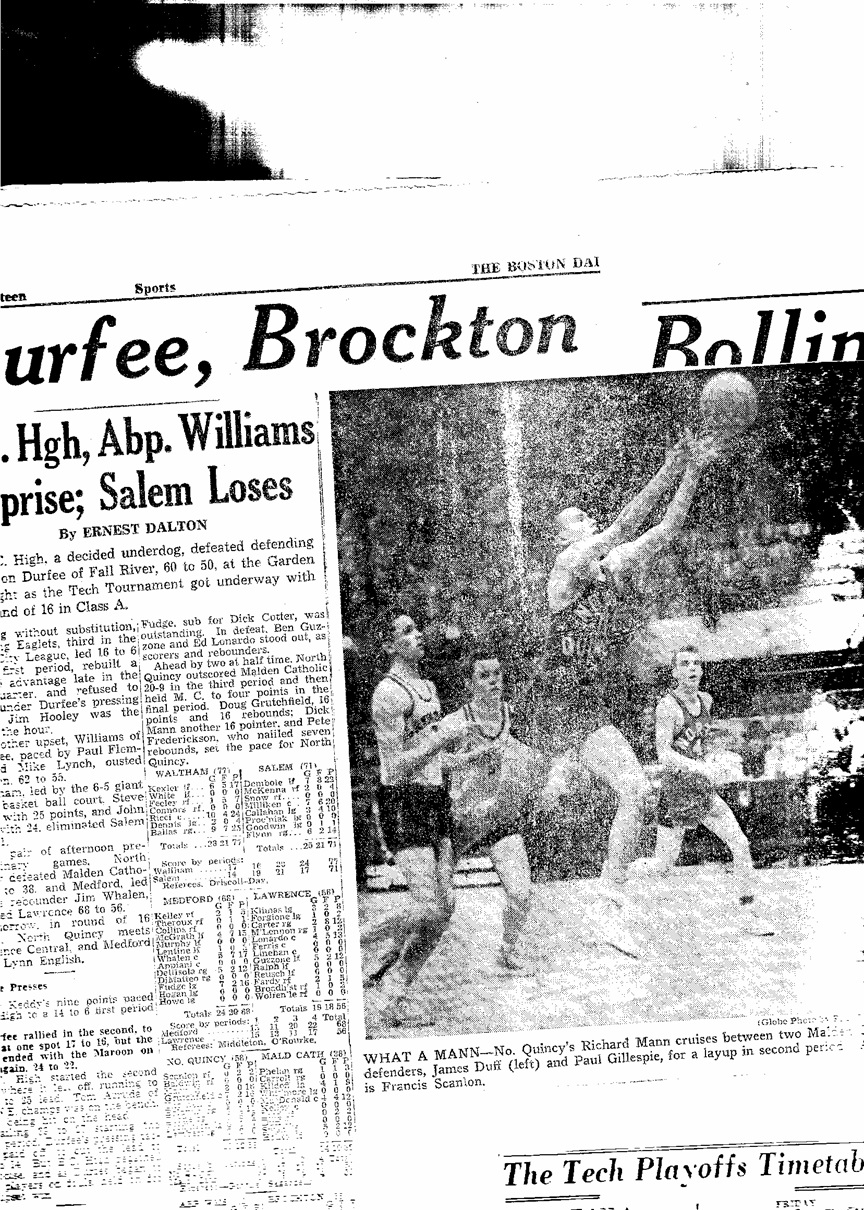
My brother told the Globe photographer to get a picture of #11 for North Quincy. He did.
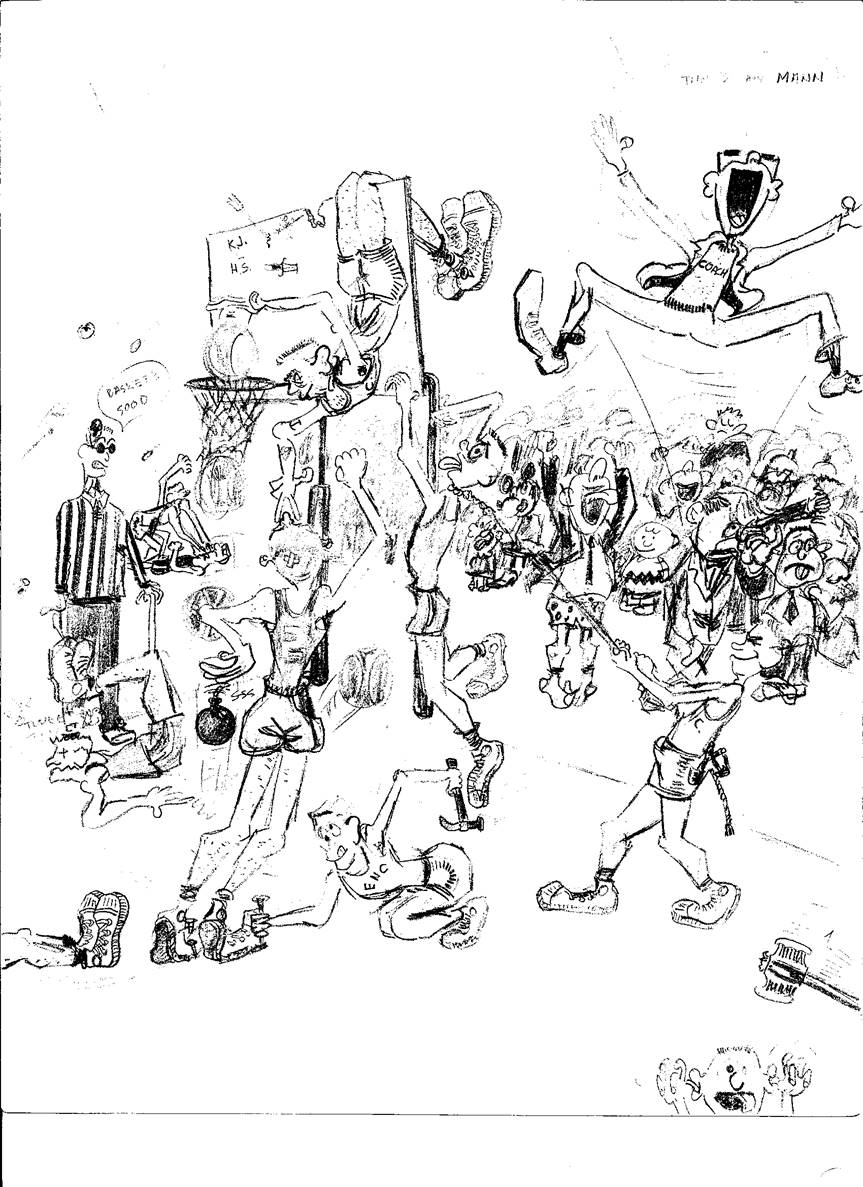
This cartoon was drawn by Colin Campbell, a fellow student and family friend. Techniques such as nailing opponent’s shoes to the floor, lassoing defenders around the neck, hiring blind refs for our home games, and hanging from the top of the backboard for easy slam dunks were all useful at times. Charlie Brown and Mickey Mouse frequently attended our games. Coach Bradley would often jump straight up in the air, shouting ‘That’s my Mann’ when I would score. However, I honestly never remember that we used mallets to pound the head of fans who attempted to make fun of cartoonists.
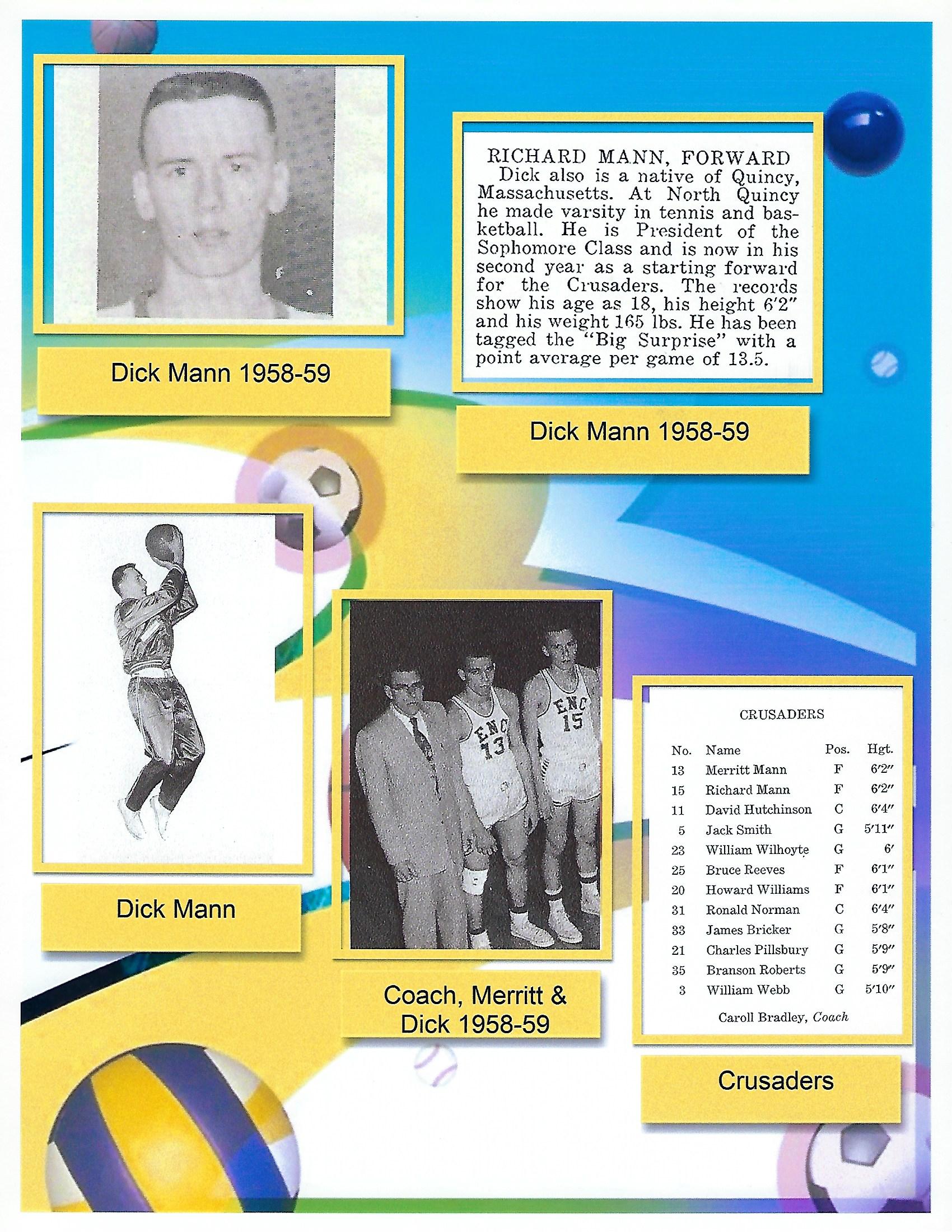
Campus Camera Profile
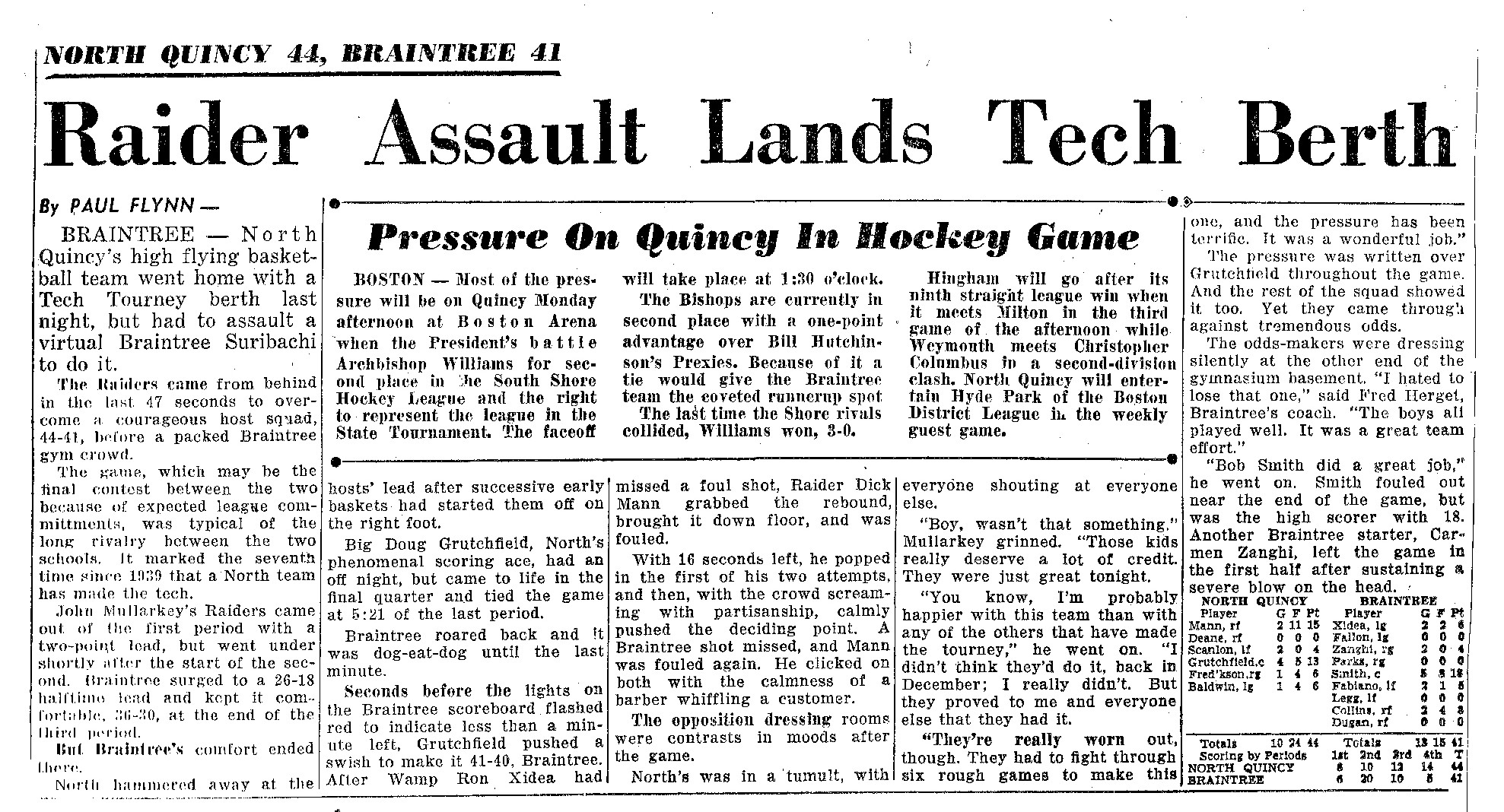
One game against Braintree High in their gym, I had two one-and-one’s at the end of the game when we were down by 2. Somehow I was able to sink all four shots, even with the place going nuts, and we won 39 – 37.
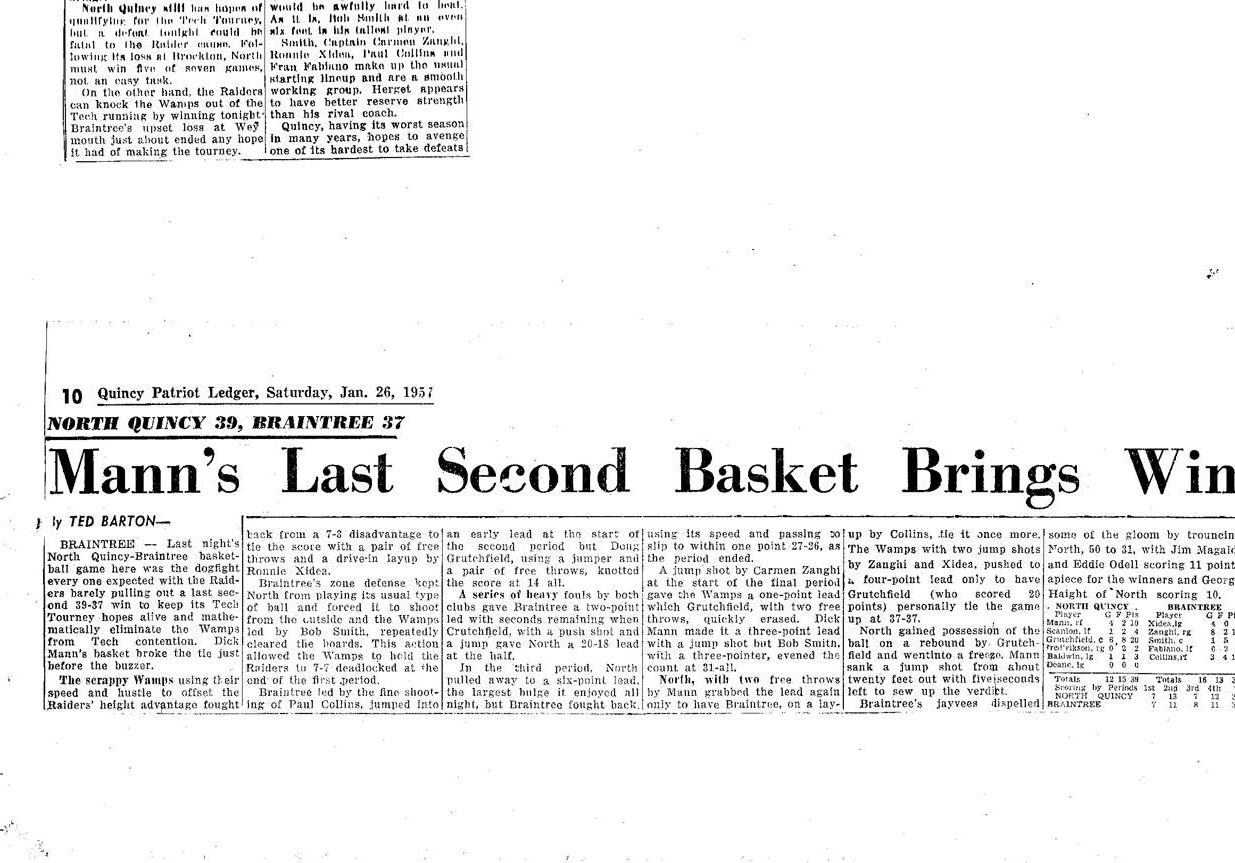
I remember feeling very awkward taking that last shot – I was amazed that it went in!
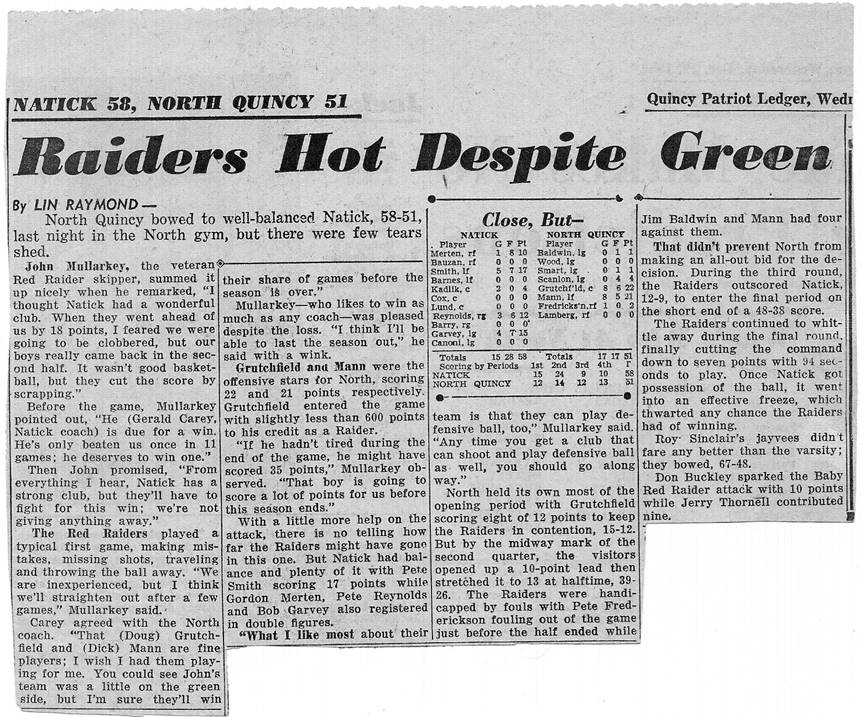
My first game as a starter for North Quincy
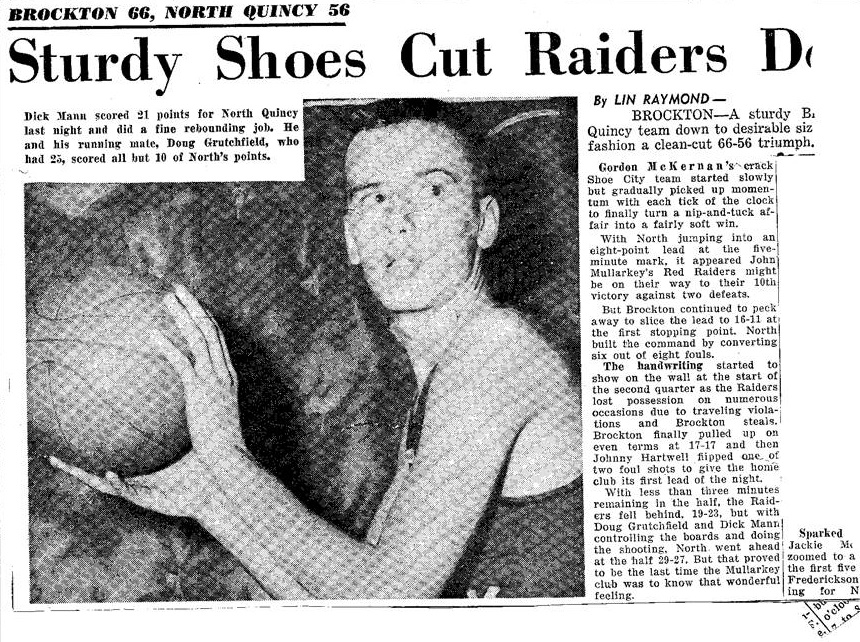
Brockton High was a sports powerhouse even back in the 50’s, but we gave them a good game for a while….
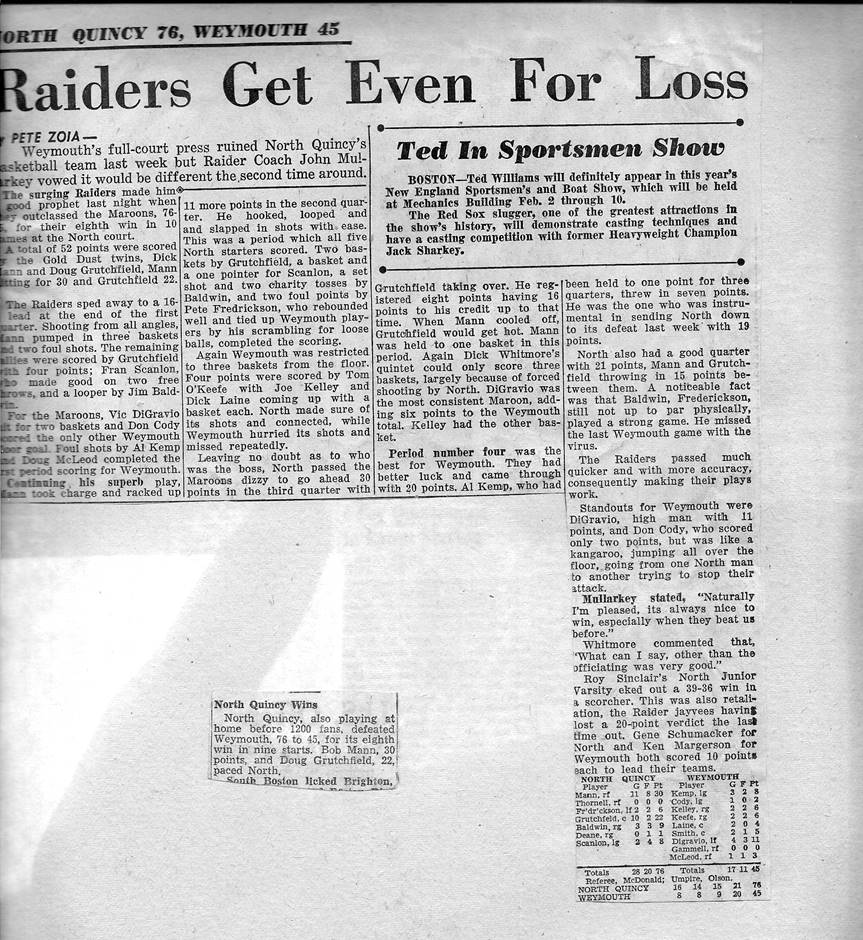
One of two times I scored 30 points in a high school game
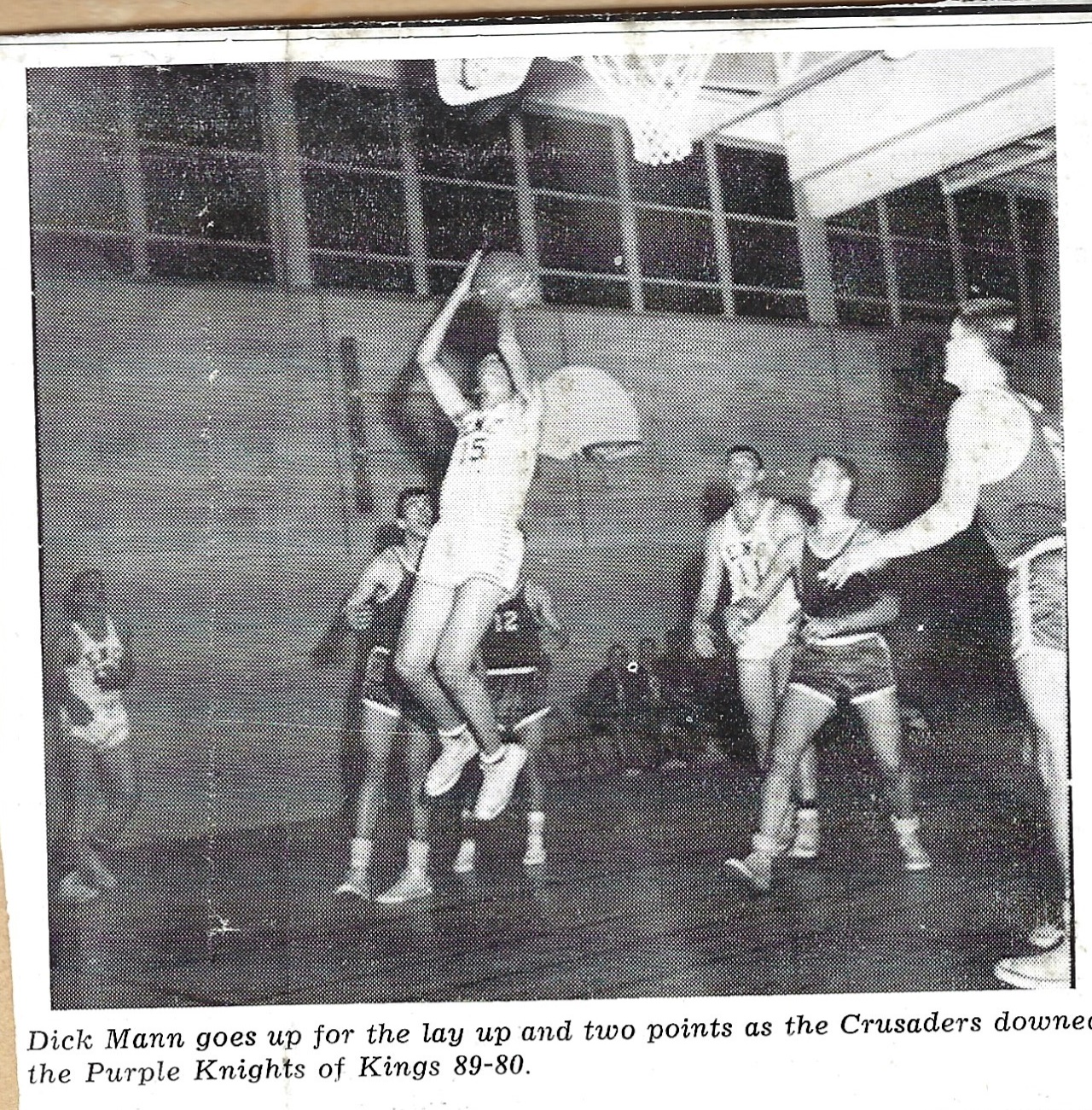
ENC Defeats Kings in Quincy – winter 1958
ENC Defeats Kings and Nyack – Winter 1958
If you still want MORE?? Here are links to 30-40 newspaper articles, mostly donated from my Dad’s files, and converted into pdf’s.